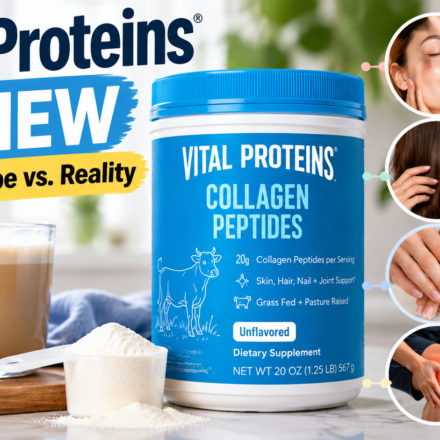
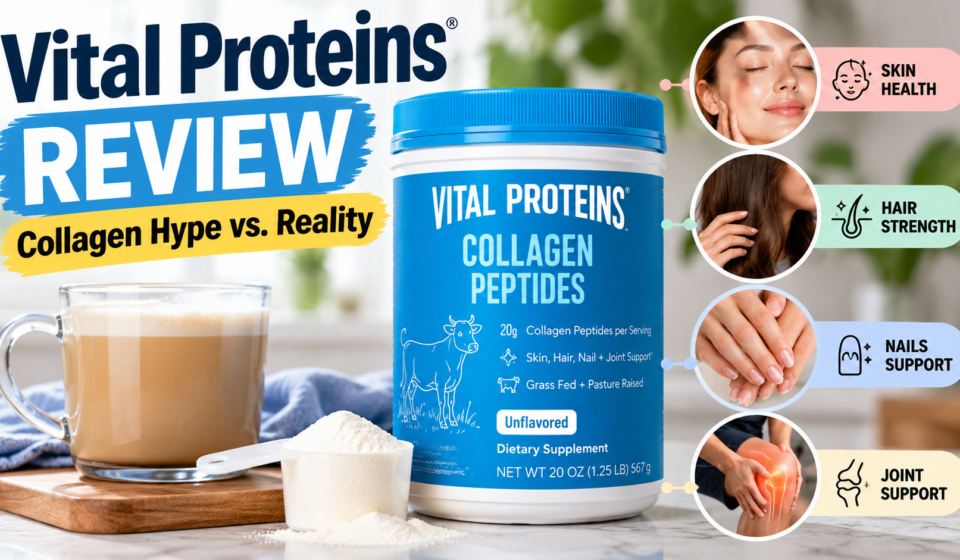

Vital Proteins Review: Collagen Hype vs. Reality, Is It Worth It?
Collagen supplements seem to be everywhere these days. From fitness influencers adding collagen powder to their morning coffee to skincare enthusiasts promoting it for younger-looking skin, collagen has become a popular part of wellness routines.
Table Of Content
- What Is Vital Proteins?
- What’s Inside Vital Proteins Collagen Peptides?
- Is Collagen a Complete Protein?
- Does Vital Proteins Collagen Actually Work?
- 1. Collagen for Skin Hydration and Wrinkles
- 2. Collagen for Joint Pain and Mobility
- 3. Collagen for Hair and Nail Growth
- 4. Collagen for Muscle Recovery and Fitness
- Vital Proteins Pros and Cons
- Vital Proteins Price: Is It Good Value?
- Are There Any Side Effects or Risks?
- How to Use Vital Proteins Collagen Peptides
- Is Vital Proteins Worth It?
- Frequently Asked Questions
- 1. Does Vital Proteins really work?
- 2. How long does Vital Proteins take to work?
- 3. Can Vital Proteins help reduce wrinkles?
- 4. Is Vital Proteins better than regular protein powder?
- 5. Can I take Vital Proteins every day?
- 6. Does Vital Proteins help with joint pain?
- 7. Is Vital Proteins suitable for vegetarians?
- Final Verdict: Collagen Hype vs. Reality
One of the most recognizable brands in this market is Vital Proteins.
The company sells collagen powders and other supplements marketed for skin, hair, nails, bones, and joint support. But do these products actually deliver meaningful results, or are consumers paying extra for clever marketing?
This Vital Proteins review examines what’s inside its collagen peptides, what scientific studies suggest about collagen supplementation, and whether the product deserves a place in your daily routine.
We’ll also look at potential side effects, pricing, and who might benefit from taking it.
What Is Vital Proteins?
Vital Proteins Collagen Peptides Unflavored
Vital Proteins is a supplement brand best known for its collagen peptide powders. Its standard unflavored collagen product uses collagen derived from bovine hide.
The brand promotes collagen as a convenient addition to drinks and recipes, with claims related to skin, hair, nails, and joint support.
Vital Proteins
Its popular unflavored formula is relatively simple, with bovine collagen peptides as the only ingredient.
That simplicity appeals to people who prefer supplements without added flavors or sweeteners. However, having a short ingredient list doesn’t automatically mean a product delivers all its advertised benefits.
What’s Inside Vital Proteins Collagen Peptides?
The main ingredient is hydrolyzed bovine collagen peptides.
Hydrolyzed collagen is collagen protein broken into smaller peptide fragments. This processing makes it easier to mix into beverages and allows the protein to be digested and absorbed as amino acids and small peptides.
A product label recorded in the National Institutes of Health Dietary Supplement Label Database lists the following nutritional information for one 20-gram serving:
| Nutrient | Amount |
|---|---|
| Collagen peptides | 20 g |
| Protein | 18 g |
| Calories | 70 |
| Sodium | 110 mg |
| Main ingredient | Bovine hide collagen peptides |
NIH Office of Dietary Supplements
These figures reflect a documented product label, not every formulation currently available. Vital Proteins also sells smaller serving formats, including products with 10 grams of collagen. Check the package you’re purchasing for its exact nutrition facts.
Is Collagen a Complete Protein?
No. Collagen is not considered a complete protein because it lacks tryptophan, one of the nine essential amino acids.
It’s especially rich in amino acids such as glycine, proline, and hydroxyproline, which play roles in connective tissue structure.
This makes collagen different from complete protein sources such as eggs, dairy, fish, meat, and soy.
If your primary goal is muscle growth or meeting daily protein requirements, collagen shouldn’t be your only protein source.
Does Vital Proteins Collagen Actually Work?
This is where the discussion becomes more interesting.
Collagen is an essential structural protein in the human body. It contributes to the strength and structure of skin, cartilage, tendons, ligaments, and bones.
But consuming collagen doesn’t mean it travels directly to your skin or joints.
Your digestive system breaks collagen down, and your body uses the absorbed components according to its needs.
Researchers have investigated whether collagen supplements can improve specific health outcomes. Some studies report benefits, but the overall evidence isn’t equally strong for every claim.
1. Collagen for Skin Hydration and Wrinkles
Skin health is one of the most heavily advertised benefits of collagen supplements.
Some clinical trials have reported improvements in skin hydration, elasticity, and wrinkles following collagen supplementation.
However, research quality matters.
A 2025 systematic review and meta-analysis in The American Journal of Medicine examined 23 randomized controlled trials involving 1,474 participants.
Although the overall results initially suggested skin benefits, analyses of higher-quality and non-industry-funded studies did not find significant improvements.
The researchers concluded that the available clinical evidence did not support using collagen supplements to prevent or treat skin aging.
PubMed
This doesn’t prove collagen can never benefit skin. It means the stronger evidence hasn’t established a dependable anti-aging effect.
Reality: Claims that Vital Proteins will noticeably eliminate wrinkles or restore youthful skin go beyond what reliable research currently demonstrates.
2. Collagen for Joint Pain and Mobility
The evidence for certain joint symptoms is more encouraging.
A 2024 meta-analysis published in Osteoarthritis and Cartilage evaluated 35 randomized controlled trials involving 3,165 participants.
Researchers found small-to-moderate improvements in pain and physical function among people with osteoarthritis who received collagen derivatives.
PubMed
Another systematic review focusing on knee osteoarthritis also reported improvements in pain and function.
PubMed
However, these studies examined different types and formulations of collagen. They don’t establish that Vital Proteins specifically produces identical results.
Collagen is also not a proven way to rebuild damaged cartilage or reverse osteoarthritis.
Reality: Collagen supplements may offer modest symptom relief for some people with osteoarthritis, but they’re not a replacement for medical treatment, exercise therapy, or other recommended care.
3. Collagen for Hair and Nail Growth
Hair and nail claims deserve more skepticism.
Hair is primarily made of keratin, another structural protein. Healthy hair growth also depends on adequate nutrition, hormones, genetics, and overall health.
While collagen provides amino acids used in protein synthesis, there isn’t strong, direct clinical evidence showing that Vital Proteins reliably increases hair growth or prevents hair loss.
Evidence for stronger or faster-growing nails is also limited.
Someone with brittle nails or thinning hair may need an assessment for other causes, including nutritional deficiencies or medical conditions.
Reality: Collagen is not an established treatment for hair loss, and dramatic hair or nail improvements shouldn’t be expected.
4. Collagen for Muscle Recovery and Fitness
Some people add Vital Proteins to protein shakes after exercise.
Although collagen contributes to total dietary protein, it contains relatively small amounts of certain essential amino acids important for muscle protein synthesis.
For building muscle, complete protein sources such as whey, soy, dairy, eggs, or balanced meals are generally better choices.
Collagen may have a role in connective tissue research, but evidence for meaningful improvements in exercise recovery remains mixed.
Reality: Vital Proteins can contribute protein to your diet, but it shouldn’t replace a complete protein supplement when muscle building is the priority.
Vital Proteins Pros and Cons
Before deciding whether to purchase the supplement, consider its practical advantages and limitations.
| Pros | Cons |
| Simple unflavored formula | Incomplete protein source |
| Easy to mix into beverages | Uncertain skin and hair benefits |
| No artificial sweeteners in the standard powder | Animal-derived, unsuitable for vegans |
| Some collagen research supports joint symptom benefits | Adds recurring supplement costs |
Vital Proteins Price: Is It Good Value?
Price matters because collagen supplements are often intended for regular use over weeks or months.
On its US website, Vital Proteins lists different container sizes and formats. A 19.3-ounce option has been listed at $39 for approximately 28 servings, although discounts, availability, and pricing may change.
Vital Proteins
If you’re purchasing collagen for general wellness, compare its cost with your existing nutrition budget.
For someone who already eats enough protein and has no specific reason to supplement collagen, the additional expense may provide limited value.
But someone interested in trying collagen for joint symptoms may consider a time-limited trial after discussing it with their healthcare professional.
Are There Any Side Effects or Risks?
Collagen supplements are generally well tolerated in clinical trials, but that doesn’t mean they’re suitable for everyone.
Some users may experience digestive discomfort, bloating, or changes in bowel habits. People with relevant animal-protein allergies should check the source carefully.
The standard Vital Proteins powder contains bovine collagen, which makes it unsuitable for vegans and certain dietary or religious restrictions.
People who are pregnant, breastfeeding, managing kidney disease, or following a medically restricted protein diet should consult a qualified healthcare professional before use.
Also remember that dietary supplements aren’t reviewed by the US Food and Drug Administration for effectiveness before reaching the market in the same way as prescription medicines.
How to Use Vital Proteins Collagen Peptides
The unflavored powder is designed to mix into everyday drinks and foods.
Popular options include coffee, tea, smoothies, oatmeal, and yogurt.
Follow the serving instructions on your particular container because package sizes and formulations differ.
There is no convincing evidence that taking collagen at a particular time of day makes it significantly more effective.
If you choose to use it, consistent intake according to the product directions is more practical than worrying about exact timing.
Is Vital Proteins Worth It?
Vital Proteins can be a reasonable collagen supplement, but it isn’t a miracle product.
Its standard powder has a straightforward ingredient list and provides an easy way to consume collagen peptides.
Research suggests certain collagen supplements may help reduce osteoarthritis symptoms, although the evidence doesn’t prove this particular brand performs better than competing products.
For skin aging, the research is less convincing when study quality and funding are carefully considered. Hair-growth claims are also weakly supported.
If you’re looking for a convenient collagen powder and understand these limitations, Vital Proteins may be worth considering.
If your main goals are building muscle, reversing wrinkles, or treating hair loss, your money may be better spent on approaches with stronger evidence.
Frequently Asked Questions
1. Does Vital Proteins really work?
Vital Proteins provides collagen peptides, but the benefits depend on the outcome you’re trying to achieve. Some research supports modest joint symptom improvements, while evidence for skin aging and hair growth remains uncertain.
2. How long does Vital Proteins take to work?
Collagen studies often assess outcomes over several weeks or months. There is no guaranteed timeframe, and some people may notice no meaningful benefit.
3. Can Vital Proteins help reduce wrinkles?
Current high-quality clinical evidence doesn’t establish that collagen supplements reliably reduce wrinkles. Results from individual studies are mixed.
4. Is Vital Proteins better than regular protein powder?
Not necessarily. Collagen has a different amino acid profile. Complete protein powders are usually better suited to supporting muscle protein synthesis.
5. Can I take Vital Proteins every day?
Many products are designed for daily use. Follow the label directions and consult a healthcare professional if you have medical conditions or dietary restrictions.
6. Does Vital Proteins help with joint pain?
Research on collagen derivatives suggests possible modest improvements in osteoarthritis symptoms. However, results vary, and this isn’t a proven treatment for every type of joint pain.
7. Is Vital Proteins suitable for vegetarians?
No. The standard bovine collagen peptide formula is animal-derived and isn’t suitable for vegetarians or vegans.
Final Verdict: Collagen Hype vs. Reality
Vital Proteins is a recognizable collagen supplement brand with a convenient, relatively simple flagship product.
However, brand popularity shouldn’t be confused with clinical proof.
The evidence is most promising for some joint-related outcomes, while claims involving younger-looking skin, faster hair growth, and dramatic anti-aging effects deserve more caution.
Our verdict: Vital Proteins may be worth trying if you want a collagen supplement and have realistic expectations. It isn’t essential for everyone, and it shouldn’t replace balanced nutrition or appropriate medical care.
The smartest purchase is one based on your health goals, the quality of scientific evidence, and whether the potential benefits justify the ongoing cost.